Cyber Essentials Plus certification can change the fine print of your cyber insurance policy, not just the price. Without it, you may face stricter conditions, higher excesses, or unexpected exclusions, even if your premium stays the same.
You might assume Cyber Essentials Plus is really just a box to tick, something that nudges your insurance premium down a bit and not much else. In practice, for a business in London that hasn't got it, the effect can run a lot deeper than that.
A missing certificate can reshape what your insurer actually puts in the policy, even while the headline price stays exactly the same. So the quote looks fine, and the real cost is hiding in the fine print you don't read until you need to claim.
Cyber Essentials Plus is a government-backed certification showing your organisation meets a recognised cyber security standard. Unlike the basic Cyber Essentials self-assessment, it involves an independent technical audit by an approved assessor - someone actually testing your systems rather than taking your word for it. That extra step is, we think, what gives insurers more confidence in how you manage cyber risk.
Which is exactly why skipping it, or stopping at the basic level, tends to show up as stricter conditions, higher excesses, or exclusions you might not spot until it's too late.

How cyber insurance underwriters use certification in their risk decisions
Underwriters need something measurable to price your risk against, and certification like Cyber Essentials Plus gives them a clean signal. Its influence doesn't stop at the premium, though - it seems to shape the shape of the policy itself.
Without a recognised certificate, an insurer may treat you as higher risk even where your actual technical controls are solid. That can translate into:
- Higher excess levels: more out of pocket before cover kicks in.
- Additional exclusions: whole categories of incident left uncovered.
- Tighter conditions: ongoing requirements like patch management or proof of malware protection just to keep the policy valid.
So certification, or the lack of it, can end up mattering more to the terms than your real security posture does - which is part of why the certificate matters even when the price on the quote doesn't move.
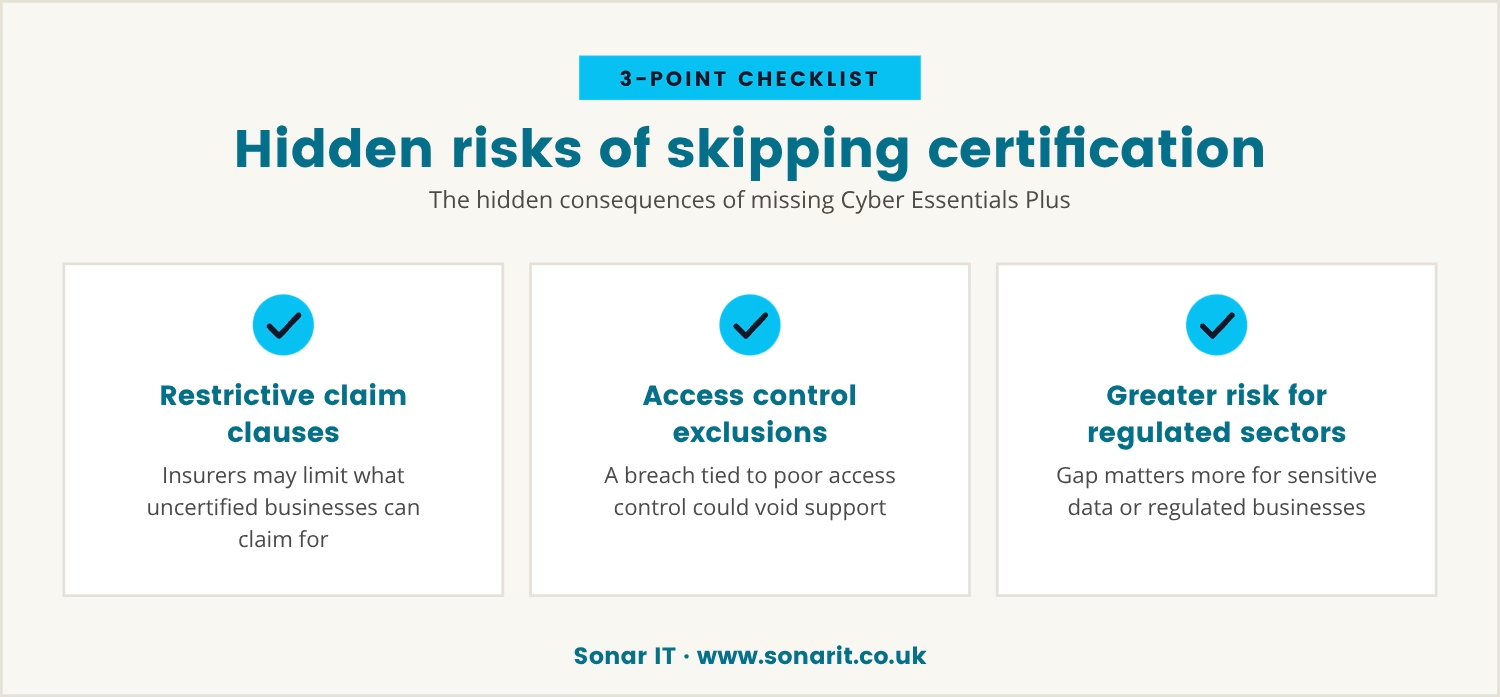
The hidden consequences of missing Cyber Essentials Plus
It's easy to fixate on the headline premium, but the real consequences, as far as we can tell, usually live further down in the policy wording.
Without certification, insurers sometimes add clauses limiting what you can actually claim for. Say you suffer a data breach and the policy excludes incidents linked to poor access control - you could be left with no support at all, even having paid the same premium as a certified business down the road. The cover looks similar on paper and behaves very differently in practice.
That gap matters more if you're handling sensitive data or sitting in a regulated sector. If your business in London leans on cyber insurance for peace of mind, it's worth checking whether the terms are quietly penalising you for not having the certificate.
Cyber Essentials Plus and policy terms: What actually changes?
Passing the technical audit is one thing; what we find more interesting is how that result feeds into the actual structure of your policy. Here's roughly how certification status tends to move the terms, as best we understand it.
Excess levels
Certified businesses often see lower excesses, so less comes out of your own pocket if you claim. Without certification, insurers may push that excess up to offset the risk they can't otherwise verify.
Claim exclusions
Some policies exclude incidents tied to things like unpatched systems unless you can show you meet a recognised standard. Certification can soften or remove those exclusions.
Additional conditions
Non-certified organisations may be asked to meet extra conditions - regular patch management, annual penetration testing - just to keep the cover in force.
Policy limits
The maximum payout can sit lower without certification, which leaves you more exposed if something serious actually happens.
Renewal scrutiny
At renewal, insurers may look again at your certification status and adjust terms accordingly. Certification seems to help keep things stable year after year, rather than shifting each time you renew.
Why insurers trust technical audits over self-assessment
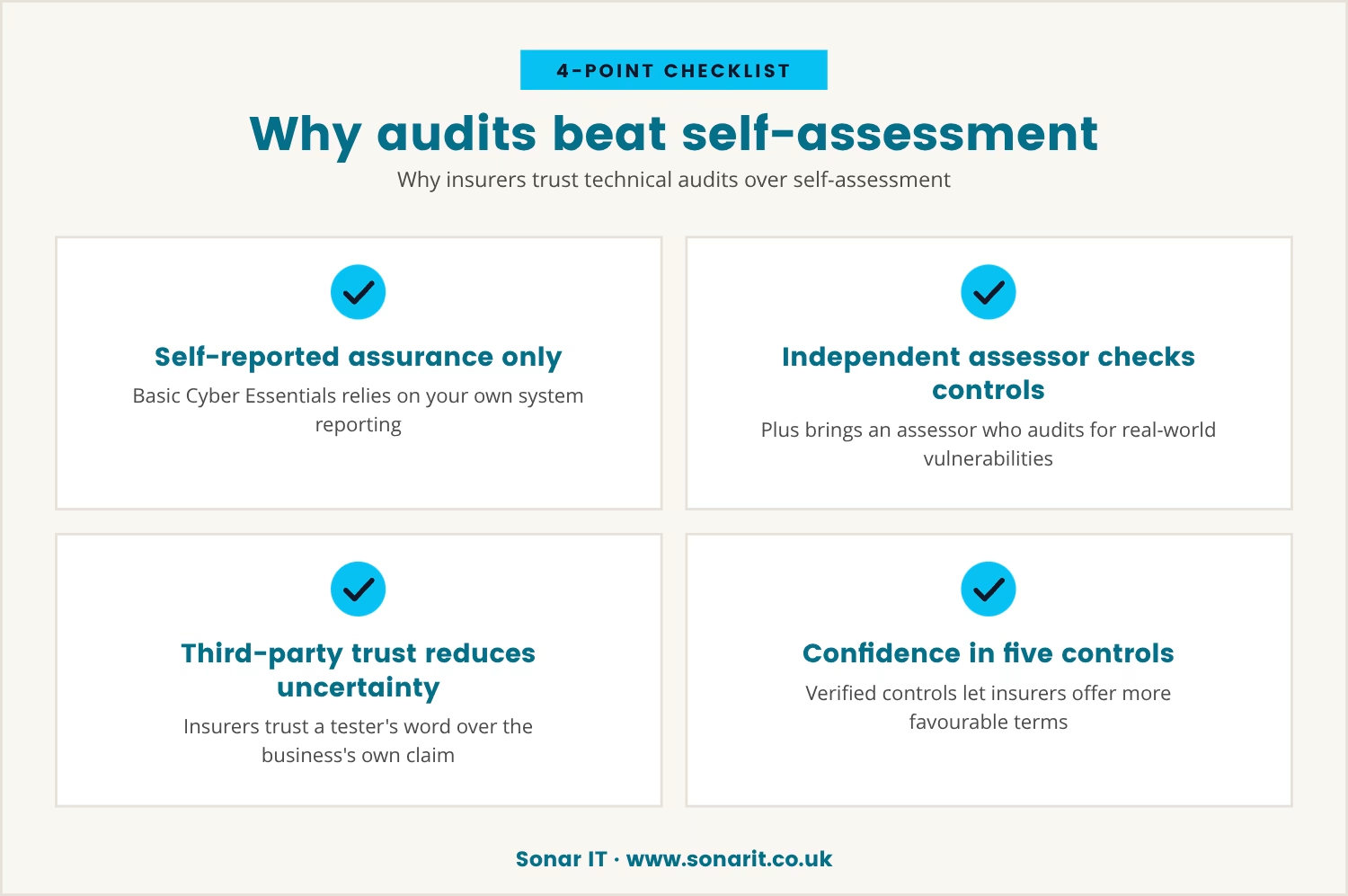
Self-assessment under basic Cyber Essentials gives a certain level of assurance, but it's built on your own reporting of your own systems. Cyber Essentials Plus instead brings in an independent assessor who actually audits those systems for real-world vulnerabilities and confirms the controls - malware protection, secure configuration - are genuinely in place.
That independent check is, we'd guess, exactly what reduces the uncertainty for an insurer: they're not trusting your word, they're trusting a third party who tested it. Knowing the five required controls are actually implemented, not just claimed, lets them offer more favourable terms with more confidence.
If you're weighing up whether to go for the Plus level, it's worth asking yourself plainly: would your current controls hold up under an outside technical audit?
How policy conditions can affect your business in London
For an organisation based in London, the conditions that come attached to certification status can have real day-to-day consequences. If your insurer expects ongoing patching or regular access reviews, keeping on top of them isn't optional - fall behind and you risk invalidating the cover entirely.
That's the uncomfortable part: a denied claim even when you genuinely believed you were protected. In a city where both the regulatory expectations and the threat levels run high, these details aren't small print to skim past.
Certification bodies approved by IASME can help you check where the gaps sit before they ever reach your insurer. Working with a local assessor tends to mean those gaps get found and closed before they show up as a declined claim.
Bullet list: Key differences between certified and non-certified policy terms
- Excess amounts: certified businesses often pay less when they claim.
- Coverage exclusions: non-certified policies tend to exclude more types of incident.
- Ongoing requirements: without certification, expect stricter patch management or access control obligations.
- Policy stability: certification seems to help keep terms consistent at renewal.
- Claims process: certified organisations may find it easier to prove compliance when a claim is investigated.
Returning to the real risk: Why the fine print matters
The surprise for a lot of businesses is that missing Cyber Essentials Plus can reshape insurance terms quietly, even while the premium itself looks unchanged. The real risk isn't just paying more - it's discovering the policy does less for you exactly when you need it most.
If you'd rather not find that out the hard way, certification is worth treating as more than a badge on the website. It's one of the levers quietly shaping what your cover actually does behind the scenes.

What to do if your policy terms feel restrictive
Many businesses with 15 to 40 endpoints find themselves surprised by the hidden conditions in their cyber insurance policy when they lack certification. At Sonar IT, we understand how frustrating it can be to discover these limits only when you need support.
We invite you to see how our team approaches cyber insurance readiness and discuss how your current setup could be affecting your policy terms.
Want policy terms that work for you?
Get your first 30 days free and a £3,000 satisfaction guarantee when you qualify for our managed IT support—so you can focus on your business, not hidden policy risks.
[.c-button-wrap2][.c-button-main2]Claim your free 30 days[.c-button-main2][.c-button-wrap2]
Frequently asked questions
What is the difference between Cyber Essentials and Cyber Essentials Plus?
Cyber Essentials is a self-assessment where you answer questions about your own controls, while Cyber Essentials Plus adds an independent technical audit that actually tests your systems against the standard. That third-party verification is what tends to carry more weight with insurers and other stakeholders.
How does ISO 27001 certification compare to Cyber Essentials Plus for insurance?
ISO 27001 is a broader information security standard covering a wide range of controls and management processes, and it's well respected in its own right. Insurers, though, often look specifically for Cyber Essentials Plus because of its focus on technical controls relevant to cyber cover - so holding both strengthens your position, but missing the Plus certificate can still affect your terms.
Who can perform a technical audit for Cyber Essentials Plus?
Only certification bodies approved and accredited by IASME can carry out the technical audit for Cyber Essentials Plus. That audit covers checking your systems for vulnerabilities, reviewing patch management, and confirming your controls are actually in place.
What happens if I fail to maintain patch management after certification?
Letting patch management slip after certification can put you in breach of your policy conditions, and insurers can deny claims linked to incidents caused by unpatched systems. Regular patching isn't just a certification requirement - it's also what keeps the insurance itself valid.
Does Cyber Essentials Plus cover all types of cyber threats?
No certification can promise protection against every kind of cyber threat. Cyber Essentials Plus focuses on five key controls - boundary firewalls and malware protection among them - so it's worth checking your policy separately for what's covered, since additional controls may be needed for risks specific to your sector.