
Frequent vulnerability scanning can overwhelm teams with alerts, hiding the real risks that matter. Fewer, deeper penetration tests that focus on how systems connect reveal exploitable paths and offer stronger protection.
When vulnerability management goes wrong, the cost is concrete: downtime, stolen data, or a breach nobody caught in time. The real question is whether running more scans closes those gaps - or just makes the backlog bigger.
We'd guess most businesses in London assume frequent scanning is the safer bet. It isn't automatically - not all security tests pull their weight, and a scan's value depends on how closely it matches the way attackers actually move through a network.
Penetration testing UK services are built to simulate those real-world attacks, but how you use them - how often, how deep, how focused - changes what you actually learn about your defences. Working out the difference between a surface-level scan and a deeper, scenario-based test is, we'd say, the whole game when it comes to spending a security budget well.

Why more vulnerability scanning can lead to less clarity
Running scans more often sounds like it should catch more problems, and on paper it does. In practice, though, frequent scanning tends to produce a flood of alerts - and a fair few of those turn out to be low priority or not exploitable in the real world.
Once a team's swamped with alerts, the genuine risks get harder to spot. All that noise can bury the handful of vulnerabilities that actually matter, which - rather than improving things - slows down response times and pulls attention away from real threats.
Over time, alerts start to feel routine, and the few that signal a real risk slip through with them. That's how you end up with a false sense of security: systems look well-monitored on the dashboard while exploitable paths sit quietly underneath.
The difference between vulnerability scanning and a penetration test
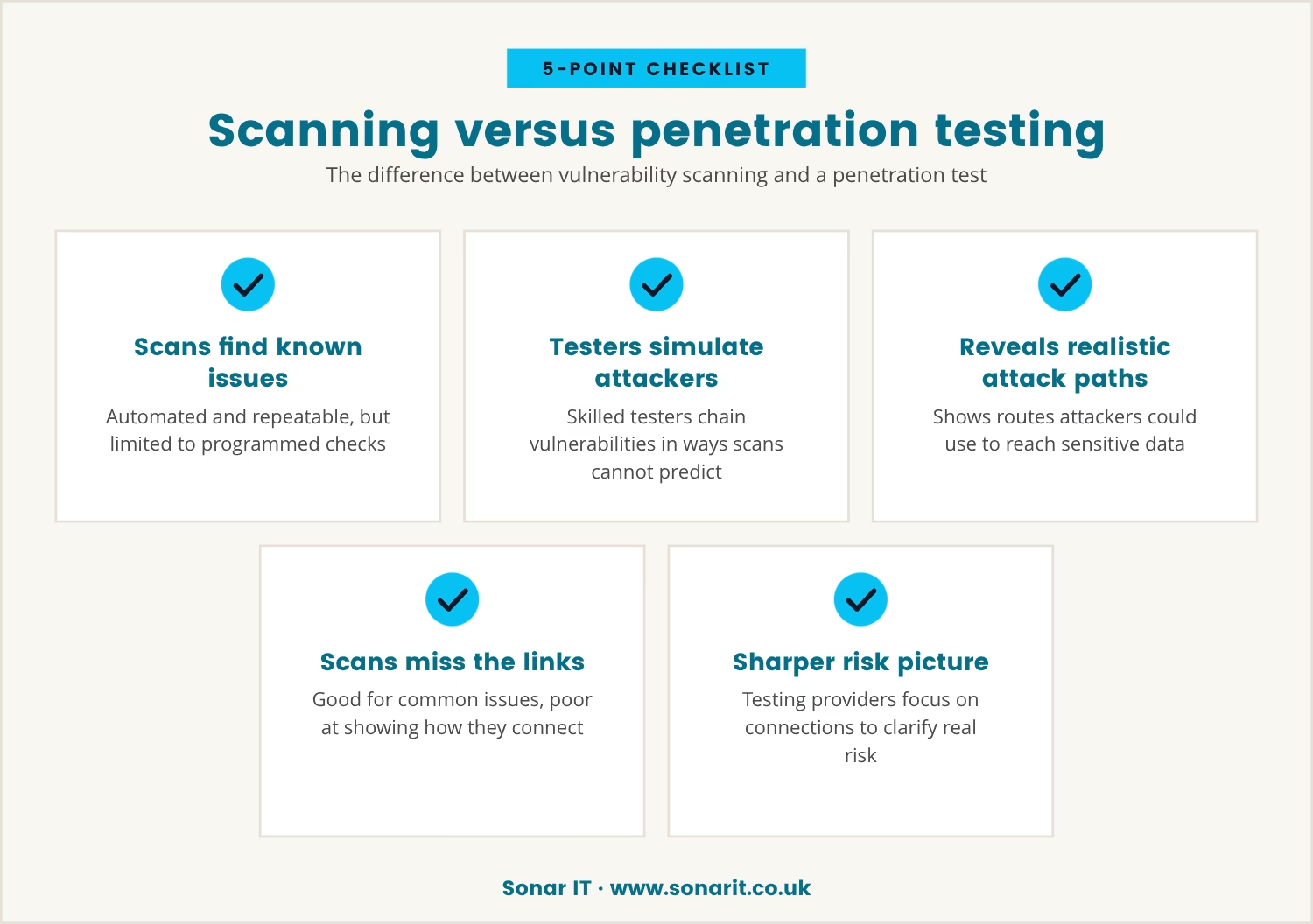
Vulnerability scanning and penetration testing get lumped together a lot, but they're doing different jobs. A scan is automated, checks for known issues, and can run as often as you like - though it only ever finds what it's been programmed to look for.
A penetration test is something else: a targeted assessment where skilled testers use their own judgement to simulate how an attacker might actually move through your network, chaining vulnerabilities together in ways no automated scan would predict. That's what shows you the paths an attacker could realistically use to reach sensitive data or disrupt the business.
Scans are genuinely useful for catching the common stuff, but they rarely show how those issues link up in a live attack. Penetration testing service providers focus squarely on those connections, which gives you a sharper picture of where your real risk sits.
Penetration testing UK: What actually improves your security posture?
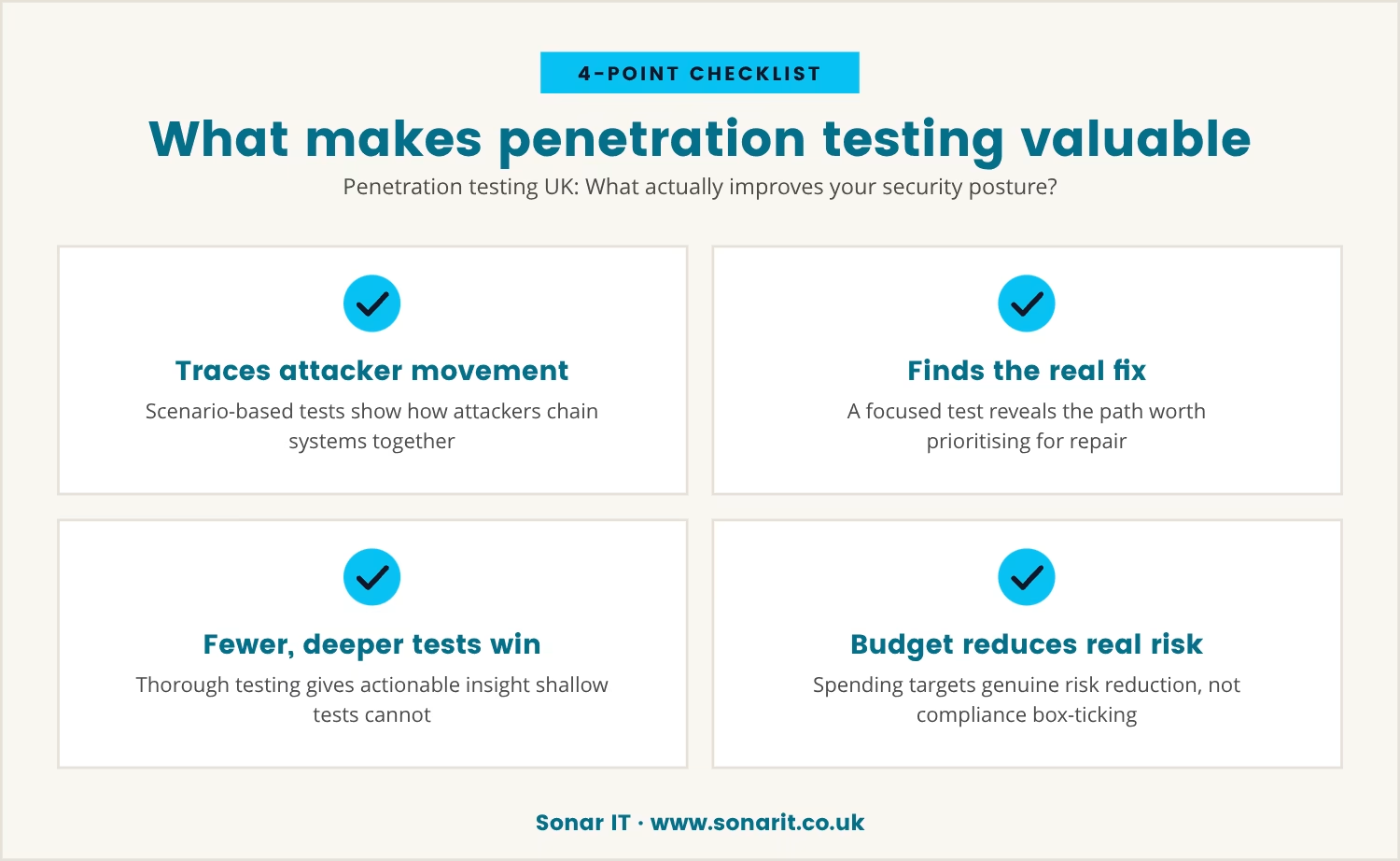
Plenty of organisations in London lean on penetration testing UK services to check their defences, and that's sensible as far as it goes. But the value isn't in how often you test - it's in how well the test reflects the way your systems are actually wired together and used.
A deep, scenario-based penetration test traces how an attacker could move from one system to the next using real-world tactics, and that's exactly what uncovers the weaknesses an automated scan misses - the ones that only show up when systems interact in ways nobody planned for.
A web application might look perfectly secure sitting on its own, for instance, but once it's connected to your internal network it could expose data nobody meant to expose. A focused test is what finds that hidden path, and finding it is what lets you prioritise the fix that actually matters.
So fewer, more thorough tests tend to buy you something a high volume of shallow ones can't: insight you can act on. That means the budget goes toward reducing real risk, not toward ticking a box.
How deep penetration tests reveal what scans miss
Penetration tests go further than a surface check, and the ways they do it are fairly specific.
Attack chain discovery
Testers look for ways small vulnerabilities can be strung together into a path toward critical systems. A scan report, by its nature, rarely shows that chain at all.
Real-world exploitation
A tester will actually attempt the exploit the way an attacker would, which is what tells you which issues are genuinely dangerous rather than just present on a list.
Context-aware assessment
Deep tests factor in how your systems get used day to day - user behaviour, business process, the lot. That context is what surfaces risks a generic scan would walk straight past.
Custom scenarios
Penetration testing companies can build scenarios around your specific setup - cloud security, web application penetration testing, whatever reflects your actual attack surface.
Prioritised findings
You get a list ranked by real risk rather than raw technical severity, which is what lets you put limited resources where they'll count.
What businesses risk by chasing scan frequency
The assumption that more scanning is always better carries some hidden costs. When a team's busy sorting through endless scan output, there's less time left to fix the issues that genuinely matter.
Budget's the other side of it. Money poured into constant scanning could instead fund a proper penetration test that uncovers the real routes an attacker might take in - so, in effect, you can end up paying more for less protection.
There's a compliance angle too. Once security turns into a checklist exercise, it's easy to lose sight of the actual goal, which is protecting your data and operations from threats that are real, not theoretical.
How to balance scanning and testing for real assurance
Getting this balance right means treating vulnerability scanning as a routine check and leaning on deep penetration tests to steer the bigger security decisions. A few practical steps help:
- Set clear goals: decide what each test type is for - routine checks from scans, in-depth risk analysis from penetration tests.
- Schedule wisely: run scans at regular intervals, but plan for fewer, more thorough penetration tests across the year.
- Focus on connections: ask your testing team to look at how systems interact, not just at individual devices in isolation.
- Review findings together: let scan results shape your penetration test scope, so you catch both the common and the complex risks.
- Invest in expertise: pick specialists who understand your business well enough to tailor the test to your actual environment.
Get that mix right and you stop paying for noise - you build a defence that actually holds up against a real attack.
Why London businesses need scenario-based testing
London's a competitive market, and businesses here are juggling compliance requirements alongside genuine cyber threats. Frameworks like Cyber Essentials and ISO 27001 set a useful baseline, but attackers aren't reading the compliance checklist - they're hunting the gaps between systems, the places automated checks tend not to reach.
Scenario-based penetration testing gives you something closer to the attacker's own view: how someone could move through your network, exploit a weak point, and reach the data that matters. That's especially worth having if your setup is complex or leans heavily on cloud services.
Understanding how your systems actually connect is, we think, what lets you decide where security spending genuinely belongs - and that's what gets you stronger protection without wasting the budget on the wrong things.

Rethinking your security approach for real results
If your business manages 15 to 40 endpoints, you may be questioning whether your current mix of scans and tests is actually making you safer. At Sonar IT, we understand how easy it is to get lost in a cycle of frequent checks that don’t always deliver real assurance.
We invite you to see how our approach to penetration testing focuses on the connections and scenarios that matter most to your business. Let’s talk about what a more targeted strategy could look like for your setup.
Want real assurance, not just more scanning?
Try our service with your first 30 days free, plus a £3,000 satisfaction guarantee for qualifying businesses—so you can see the value of deeper testing without the risk.
[.c-button-wrap2][.c-button-main2]Start your free 30 days[.c-button-main2][.c-button-wrap2]
Frequently asked questions
How does a penetration test differ from regular vulnerability scanning?
A penetration test is hands-on: testers simulate real attacks to find actual ways into your systems. Vulnerability scanning is automated and flags known issues, but it won't show you how those issues could be combined to breach your defences.
Should we use testing companies in the UK for compliance or real security?
Compliance matters, but basic checks alone can leave gaps that attackers are happy to use. Testing companies in the UK running scenario-based penetration tests help you address the actual risk, not just the regulatory minimum.
How often should a small business schedule a network security audit?
A small business with somewhere around 15 to 40 endpoints should probably run vulnerability scans regularly - monthly or quarterly works for most. A deeper network security audit or penetration test is better scheduled at least once a year, or whenever major systems change.
What makes a penetration testing service valuable for cloud security?
A good penetration testing service tailors itself to your cloud setup, looking specifically at how cloud systems interact with whatever you're still running on-premises. That's what tends to uncover risks a standard scan would miss.
Can a pen test help us identify vulnerabilities in web applications?
Yes - a pen test can simulate attacks against your web applications and surface weaknesses automated tools tend to overlook. That's particularly useful if your business depends on web-based services or handles sensitive customer data.